
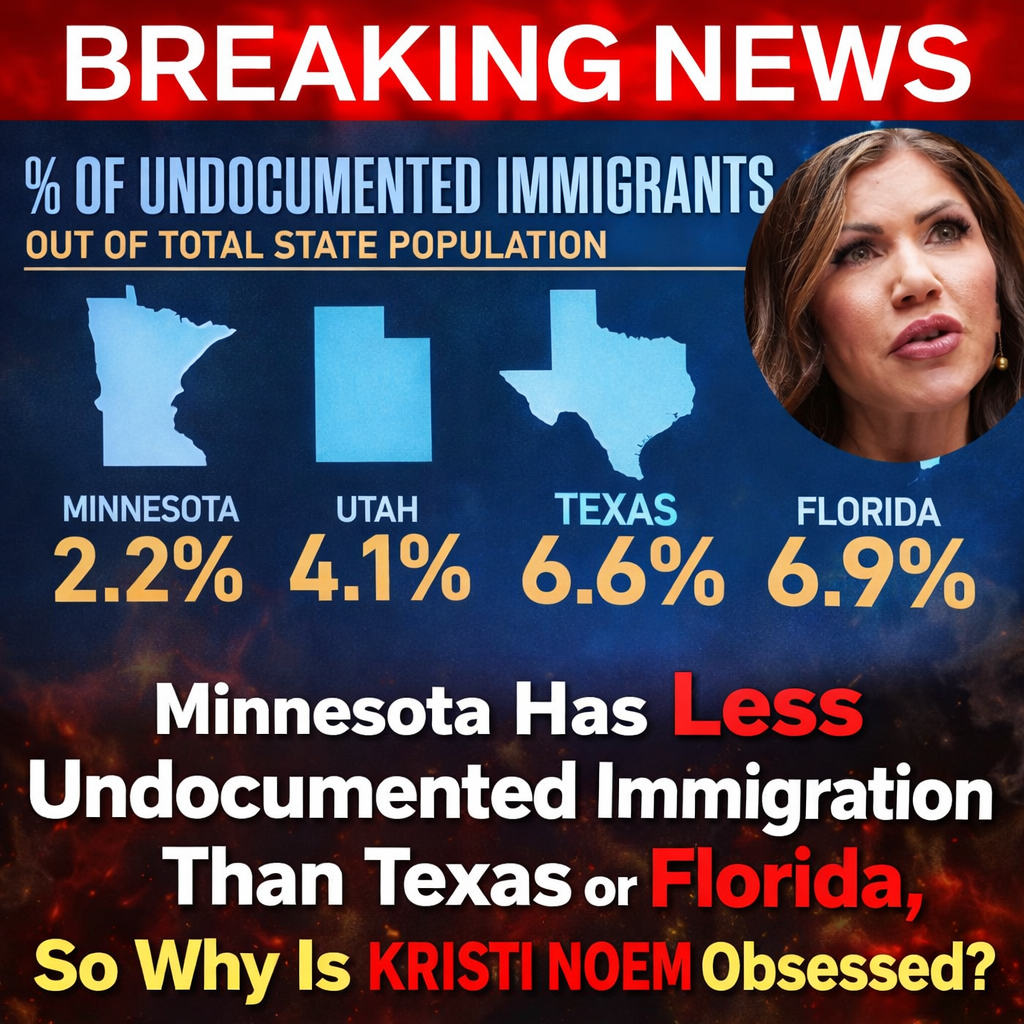
A newly circulated data graphic is fueling sharp criticism of immigration enforcement priorities and raising questions about political motives behind recent actions led by Kristi Noem. The numbers, sourced from the Pew Research Center, show that Minnesota has a significantly lower percentage of undocumented immigrants compared to conservative-led states like Texas and Florida—yet Minnesota appears to be receiving disproportionate attention.
According to the data, undocumented immigrants make up approximately 2.2 percent of Minnesota’s total population. By contrast, Utah stands at about 4.1 percent, Texas at 6.6 percent, and Florida at 6.9 percent. Despite this clear disparity, critics argue that enforcement messaging and political theater have been aimed far more aggressively at Minnesota than at states with substantially higher undocumented populations.
This has led many observers to ask a pointed question: if immigration enforcement were truly about removing dangerous criminals and addressing border security concerns, why not focus resources where undocumented populations are largest? Why not prioritize Texas and Florida, two states that frequently position themselves as leaders on immigration crackdowns?
Instead, critics say, the focus on Minnesota appears calculated for visibility rather than effectiveness. Minnesota is a Democratic-leaning state, and actions taken there are more likely to generate headlines, cable-news debates, and viral social media moments. Supporters of this view argue that enforcement efforts aimed at blue states create a political narrative, even if they do little to address the underlying issue at scale.
Immigration advocates and policy analysts have pointed out that meaningful enforcement requires coordination, data-driven strategies, and a focus on genuine public safety threats. Targeting states with lower undocumented populations, they argue, undermines claims that the operations are about crime prevention rather than political optics.
The criticism has also highlighted the absence of similar pressure on Republican governors such as Ron DeSantis and Greg Abbott. Both preside over states with significantly higher undocumented populations, yet neither appears to be the focus of the same level of scrutiny or intervention. Detractors say this inconsistency weakens the credibility of the broader enforcement narrative.
Defenders of Noem argue that immigration enforcement should not be judged solely by population percentages and that federal and interstate actions are complex. However, critics counter that complexity does not excuse selective targeting that aligns neatly with partisan messaging.
At its core, the controversy underscores a deeper national tension over immigration policy. Is the goal to reduce undocumented populations in a measurable, effective way—or to signal toughness to a political base? When enforcement choices appear disconnected from the data, skepticism grows.
As immigration remains one of the most polarizing issues in American politics, the numbers presented in this debate have added fuel to an already intense fire. For many Americans, the question is no longer just about borders or laws, but about honesty, consistency, and whether political leaders are willing to put results above rhetoric.
For now, the data speaks plainly—and it is forcing a difficult conversation about priorities, politics, and the true purpose behind high-profile immigration operations.
Citations: https://www.axios.com/local/twin-cities/2025/08/25/minnesota-unauthorized-immigrant-population-pew