
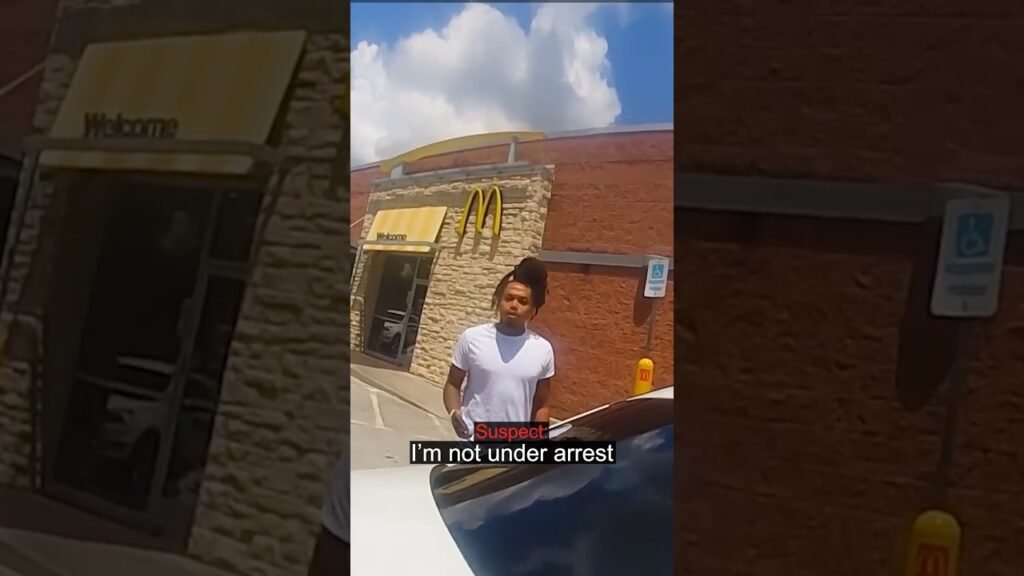
A newly surfaced bodycam video captures the moment a routine police conversation shifts into a high-risk encounter after dispatch unexpectedly reports the man officers are speaking with as “armed and dangerous.” What begins as a casual, almost friendly exchange in a parking lot rapidly evolves into a tense and cautious police procedure, illustrating how unpredictable field interactions can become once new information enters the situation.
The footage opens with the suspect approaching officers on his own. He calmly tells them, “We’re the ones that called,” making it clear that he believes he is helping law enforcement, not being investigated. Standing next to a white sedan under bright daylight, he appears relaxed, cooperative, and unaware of any danger associated with his name or presence. His posture and tone reflect someone reporting an issue rather than someone avoiding one.
Moments later, the man tries to clarify details, telling police, “You know I try the fry… but they’re not hot,” describing something he observed or attempted to report. The officers listen casually, showing no signs of alarm. At this point, the encounter resembles dozens of ordinary service calls officers respond to each day—fast, simple, and relaxed.
However, everything changes once officers return to their patrol car to “run his name.” As one officer types into the onboard computer, the police radio interrupts the calm atmosphere. Dispatch announces the critical information that alters the tone of the entire encounter: “Wanted person… armed and dangerous.”
This moment is where routine police work transforms into potential threat management. Officers must immediately adapt their posture, language, and tactics. Whether the dispatch alert is accurate, outdated, mistaken, or misapplied does not matter in the moment—the possibility of a dangerous individual forces officers into caution.
Upon re-engaging with the suspect, the officers’ tone becomes noticeably firmer. They reposition him away from vehicles and toward a brick building. One officer instructs him, “I’m gonna walk you…”—a controlled directive used to move subjects into safer, more manageable spaces. The suspect, who believed this was a simple conversation, begins to show confusion as officers tighten their control.
In a later moment, another officer comments, “Just a criminal trespass,” revealing potential conflicting information circulating among officers and dispatch. This inconsistency mirrors real-world policing where data from different sources does not always align instantly.
As the tension rises, the suspect asks, “Why are you doing that?” His confusion grows, expressed again in another frame: “No, what you mean yeah!?” His body language shows surprise rather than aggression—he does not flee, resist, or threaten. Instead, he tries to understand why the officers’ demeanor changed so abruptly.
Toward the end of the video, an officer accidentally trips while maneuvering around the suspect—a small but humanizing moment in a high-stress environment. This stumble underscores the chaotic nature of real policing, where officers must juggle safety, communication, and movement simultaneously.
The video ends without showing an arrest or the final resolution. Still, it highlights how the introduction of a single dispatch alert can transform a peaceful interaction into a potential high-risk situation. It also reveals the delicate balance officers must maintain: respecting a cooperative citizen while preparing for the worst-case scenario dictated by their training and information systems.