
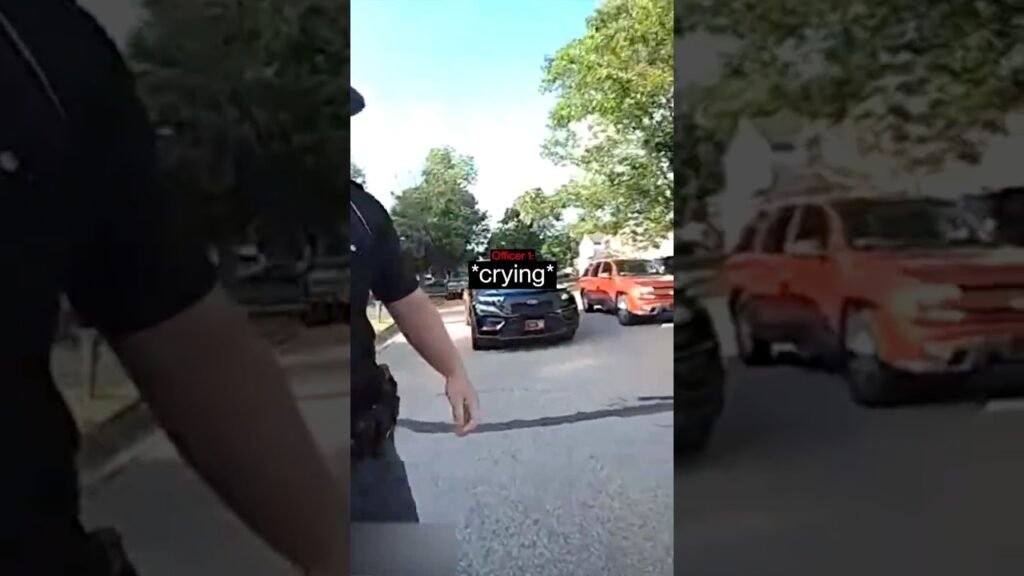
A tense moment unfolded during what appears to be a traffic-related police encounter when an officer unexpectedly discharged his Taser or firearm, causing immediate confusion among the responding units. The body-worn camera footage captures the raw reaction of multiple officers as they try to understand what happened and make sure no one on scene is injured. What began as a routine, controlled police response quickly shifted into a chaotic moment that demanded instant attention and assessment.
The video opens with officers standing around a truck stopped in the middle of a residential street lined with trees and parked cars. Suddenly, one officer recoils in shock and frustration, blurting out, “Dude, what the f**k?” His reaction instantly signals that something has gone wrong. The camera angle shows another officer, visibly shaken and looking down at his equipment. His body language suggests that the discharge was unintentional, and the confusion spreads among the officers nearby.
Within seconds, more officers approach, trying to piece together the situation. One of them asks sharply, “What’d you do that for?”—not as an accusation, but as an attempt to understand the cause of the unexpected activation. The truck remains boxed in by police vehicles, indicating that the officers were already engaged in a larger incident before the accidental discharge occurred.
The tone shifts as a sergeant arrives on scene. Recognizing the stress on the officer involved, he asks calmly and directly, “Did you discharge?” His voice is measured, focusing on clarity rather than blame. The officer nods or responds in a way that confirms it, prompting the sergeant to shift into reassurance rather than interrogation. “Breathe,” he tells him, guiding the officer through the moment and grounding him after the shock of the incident.
The interaction highlights an often unseen side of police work—the emotional and physical pressure officers experience during sudden, high-adrenaline moments. Even when situations appear controlled, stress can spike instantly, leading to mistakes or equipment misfires. The sergeant’s response reflects the importance of leadership during uncertain events, showing how supervisors help stabilize both the scene and their officers.
Around them, other officers remain focused, keeping the area secure while still checking back to ensure their colleague is okay. Their divided attention illustrates the multitasking required in law enforcement: managing safety, documenting incidents, and providing support simultaneously. Despite the jolt of the accidental discharge, the team regains control quickly, demonstrating professionalism and cohesion.
The setting—a peaceful suburban street—contrasts sharply with the intensity of the moment. The scene is a reminder that police incidents can escalate in any environment, and even routine stops can shift unexpectedly. Accidental discharges, while rare, are taken seriously in law enforcement due to the risk they pose and the emotional toll they can take on the officer involved.
As the video concludes, the situation appears to stabilize. The officers regroup, assess the potential risks, and begin the necessary follow-up actions to document what occurred. The officer at the center of the event is visibly calmer after the sergeant’s reassurance, underscoring the value of experienced leadership during stressful scenes.
This incident highlights both the unpredictability of police work and the human reactions that unfold when unexpected events occur. It stands as a powerful example of rapid response, support, and recovery inside an active law enforcement environment.