
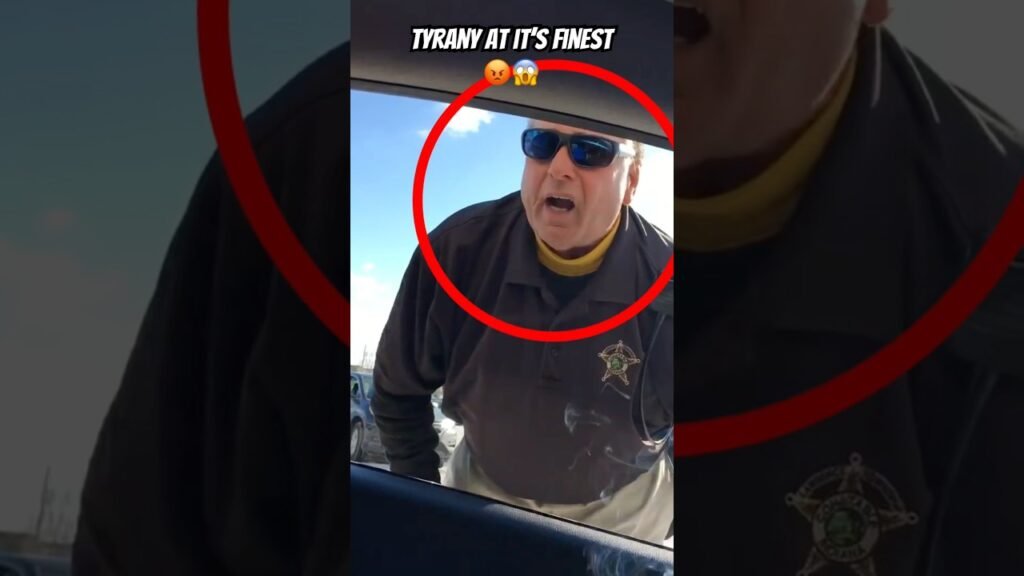
A now-viral recording shows a tense exchange between a sheriff’s deputy and a driver who refuses to present identification during a roadside stop. The video, filmed entirely from inside the vehicle, captures the deputy repeatedly requesting a driver’s license while the individual behind the camera pushes back, questioning the legality of the stop and asserting his right not to comply.
The footage begins with the deputy standing at the driver’s window, leaning down to speak through the partially open glass. The officer calmly but firmly asks for identification, stating that the driver is required to provide his license. Instead of complying, the driver immediately challenges the request, asking, “For what?” and insisting that he has committed no crime.
As the exchange continues, the deputy explains that the stop was initiated due to a “traffic infraction.” Although the specifics of the violation are not captured in the video, the officer repeatedly mentions it as justification for the ID request. The driver, however, maintains that no crime has occurred and therefore he is not obligated to hand over his documentation.
Throughout the clip, the tension visibly increases. The driver demands a supervisor, a common request in rights-based confrontations. The deputy remains at the window, attempting to clarify that a traffic infraction still requires the driver to identify himself. At one point, the officer tells the man, “You don’t even…” before being interrupted, indicating frustration with the driver’s unwillingness to engage in a cooperative dialogue.
Around the middle of the video, the officer’s tone shifts from explanation to enforcement. He states plainly that a “crime is taking place,” referring to the driver’s refusal to follow lawful orders during a traffic stop. Legally, failing to present ID when required can escalate a simple infraction into a detainable offense, and the officer appears to be preparing for that next step.
Despite the escalation, the deputy maintains professional body language throughout the encounter. He stays positioned at the window, hands visible, and avoids physical confrontation. The driver, meanwhile, keeps filming and insists on arguing each point, further prolonging the already strained interaction.
The final frames of the video show the standoff still unresolved, with the deputy explaining what laws apply and the driver doubling down on his refusal to provide identification. As the clip ends, viewers are left without closure regarding whether the interaction resulted in an arrest, a citation, or a supervisor’s arrival.
Encounters like this continue to spark online debate about the boundaries of police authority, the obligations of drivers during traffic stops, and the role of citizen recordings in shaping public opinion. While advocates of constitutional audits argue that such refusals protect civil liberties, law enforcement agencies emphasize that compliance with lawful orders is necessary for safety and legal accountability.
This footage highlights how quickly a simple traffic infraction can escalate when communication breaks down and neither side bends. It serves as a reminder that traffic laws, ID requirements, and officer safety protocols remain central discussions in today’s policing environment.